How to Solve Stubborn Drain and Sewer Blockages in Valinhos SP
How to Solve Stubborn Drain and Sewer Blockages in Valinhos SP
By the end of this article, you will know exactly which alternative to try when plungers, caustic soda, and DIY snakes have all failed — and when it is time to call a professional desentupidora em Valinhos SP. The goal is not just to clear the pipe today, but to understand why the usual methods fell short so the same blockage does not return next month.
Valinhos sits in a region with a mix of older homes, newer condominiums, and commercial buildings, and each type of property produces its own pattern of drain failure. A method that works in a brand-new apartment may be useless in a 1980s house with cast-iron pipes and tree roots nearby. The problems below are the ones that most often defeat the standard toolkit, followed by the fix that actually works.
Problem 1: The Plunger Only Moves the Water, Not the Blockage
Plunging creates pressure, and pressure works best on soft, localized clogs near the drain opening. When the blockage sits several meters down the line, or when it is made of hardened grease and soap scum, the plunger simply pushes water past it and the drain appears to recover for a few hours. The water drains slowly again by evening, and the cycle repeats.
Why repeated plunging can make things worse
Every plunge adds stress to the joints and seals of older pipework. In Valinhos, many houses still have clay or cast-iron sections that are already brittle, and repeated pressure can turn a simple clog into a leak behind the wall. If you have plunged three times without a permanent result, stop and treat the blockage as a deeper obstruction.
The fix: mechanical clearing at the right depth
A drain snake or auger reaches the obstruction and either breaks it up or pulls it out. The key is using a cable long enough to reach the main line, not just the trap. For a desentupidora Valinhos call, a technician will first measure how far the cable travels before it meets resistance, which tells them whether the clog is in the branch line or already in the street connection.
Problem 2: Chemical Drain Cleaners Leave a False Sense of Repair
Caustic soda and enzyme products are sold as a quick fix, and they do dissolve some organic matter. The problem is that they work only on the surface of the clog and often leave a hardened ring of residue on the pipe wall. That residue narrows the pipe and becomes the anchor for the next blockage, which usually arrives within weeks.
When chemicals are genuinely useful
Chemical cleaners have a place in maintenance for slow-running drains with light grease buildup, and they can help keep a clean pipe clean. They are not a solution for standing water, sewage backup, or a drain that has stopped completely. In those cases the chemical sits on top of the blockage, damages the pipe if left too long, and creates a hazardous splash risk for anyone who later opens the line.
The fix: remove the residue, not just the center
Professional clearing removes the entire obstruction and then flushes the pipe walls. In many Valinhos homes, this is done with a rotating cable followed by a water jet, which is the same principle used in desentupidora Valinhos SP emergency calls where the drain has already backed up into the floor.
Problem 3: Tree Roots Have Entered the Sewer Line
This is the classic failure in older neighborhoods, and it is the one that most often defeats every household method. Roots find tiny cracks at pipe joints, enter seeking moisture, and grow into a dense mat that catches paper, grease, and waste. You may clear the line temporarily, but the root remains and regrows.
Signs that roots are the real cause
- Blockages return in the same spot every few months.
- Multiple drains in the house slow down at the same time.
- You hear gurgling from the toilet when the shower runs.
- The yard has unusually green patches above the sewer path.
The fix: cutting and, if needed, relining
A root cutter attached to a rotating cable shaves the roots from the inside of the pipe. This restores flow, but it is a maintenance action rather than a permanent cure. If the pipe is cracked or offset, the long-term fix is a trenchless liner or spot repair, which a qualified team can assess after camera inspection.
Problem 4: The Blockage Is in the Main Line, Not the House
Homeowners often assume the problem is inside their property, but the sewer main under the street can also be blocked, especially after heavy rain or in areas with aging infrastructure. When the main is restricted, every house upstream experiences slow drains and backups, and no amount of work inside the house will solve it.
How to tell house line from main line
A camera inspection is the only reliable way. It shows whether the obstruction is within the property boundary or beyond it, and it documents the condition of the pipe for the utility or condominium administration. For commercial properties and condominiums, this record is often required before any shared-line repair is approved.
The fix: coordinate with the right responsible party
If the blockage is on the public side, the water utility handles it. If it is on the property side, an emergency team clears it and provides a report. A professional service such as Desentupidora Suprema works with both scenarios and can tell you which side you are on before you spend money on the wrong repair.
Problem 5: Grease and Soap Scum Have Built a Hard Layer
Kitchen drains in restaurants and busy homes accumulate fat that cools and solidifies on the pipe wall. Over time the layer hardens into a soap-like crust that narrows the pipe until only a trickle passes. Liquid drain openers barely touch it because the crust is not water-soluble.
Why hot water is not enough
Hot water melts a thin film but does not remove the adhered layer. In fact, repeated hot-water flushing can push softened grease farther down the line, where it cools again and creates a second blockage. The result is a pipe that seems clear near the drain but backs up several meters away.
The fix: high-pressure water jetting
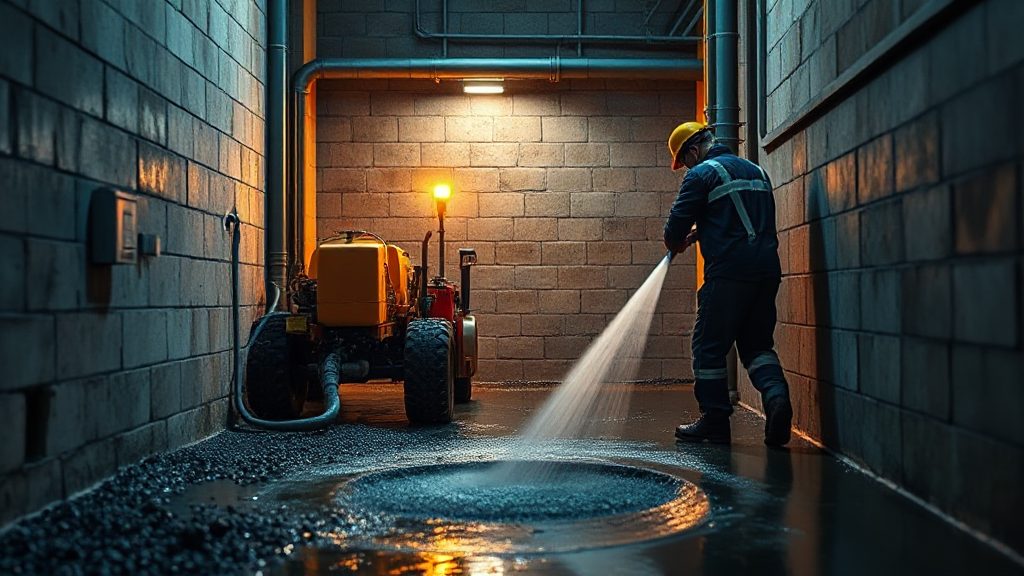
Hydro jetting uses controlled high-pressure water to scour the full circumference of the pipe, removing grease, scale, and sediment. It is the standard method for commercial kitchens and for any line where the blockage is a coating rather than a solid object. After jetting, a preventive schedule — often every six to twelve months — keeps the line from returning to the same state.
Problem 6: The Septic System Is Full or Failing
Properties outside the central sewer network rely on septic tanks and drain fields. When the tank fills with solids or the drain field becomes saturated, the symptoms look exactly like a blocked drain: slow fixtures, gurgling, and backups at the lowest drain in the house. Clearing the pipe does nothing because the real problem is downstream.
What a proper assessment includes
A technician checks the tank level, the condition of the inlet and outlet baffles, and the drain field. If the tank is full, pumping is the fix. If the drain field is clogged, the solution may involve jetting the distribution lines or, in severe cases, replacing part of the field. Doing this before the system fails completely is far cheaper than an emergency replacement.
The fix: pump, inspect, and schedule
Septic tanks should be inspected annually and pumped when solids reach roughly one-third of the tank depth. In Valinhos, where many properties have mature landscaping and limited access, scheduling the pump before the rainy season avoids the worst-case scenario of a backup during a storm.
Problem 7: You Cannot Find the Access Point or the Cleanout Is Sealed
Some properties have no accessible cleanout, or the cleanout has been buried under paving, tile, or landscaping. Without an access point, every method becomes guesswork, and a technician may need to create one. This is common in older homes that were renovated without updating the plumbing layout.
Why access matters more than the tool
The best equipment in the world cannot clear a line it cannot reach. A proper access point lets the technician enter the pipe at the right angle, inspect it with a camera, and clear it without damaging the fixtures. Installing a cleanout is a small job compared with the cost of repeatedly clearing a line through a toilet or roof vent.
The fix: locate, open, and document
Camera inspection and line tracing can find the buried cleanout or confirm where a new one should go. Once access is established, the clearing is faster and the result is verifiable. This is also the moment to record the pipe layout for future maintenance, which is especially useful for condominiums and commercial buildings.
Comparing the Alternatives: What to Try Before You Call
Not every blockage requires an emergency call, but knowing the limits of each method saves time and money. The table below summarizes what each approach can and cannot do, based on the failure patterns above.
| Method | Best for | Limitation |
|---|---|---|
| Plunger | Soft clogs near the drain opening | Cannot reach deeper than the trap |
| Chemical cleaner | Light grease maintenance | Leaves residue; unsafe for standing water |
| Hand snake | Hair and small objects in branch lines | Too short for main lines; can damage old pipes |
| Hydro jetting | Grease, scale, and sediment coating | Requires professional equipment and access |
| Camera inspection | Diagnosing roots, cracks, and main-line issues | Diagnostic only; clearing follows separately |
If you have tried the first three and the problem persists, the remaining options require professional equipment. That is the point at which a desentupidora em Valinhos SP becomes the practical choice rather than an expense to postpone.
When to Stop Trying and Call a Professional
The decision point is not dramatic. It arrives quietly: the drain clears and then slows again within days, or two fixtures back up at once, or you notice a smell that was not there before. Those are signals that the blockage is structural or located beyond the reach of household tools.
Professional teams bring three things a homeowner cannot: a camera that shows the actual cause, equipment that clears the full pipe diameter, and a report that documents the condition for warranty, insurance, or condominium records. In an emergency — sewage backing into a ground-floor bathroom at night — the priority is containment and fast clearing, which is why 24-hour services exist.
For residents and property managers in Valinhos, the practical rule is simple. Try the plunger once, avoid repeated chemical treatments, and if the water does not stay gone, stop. A proper diagnosis costs far less than a flooded floor, and it turns a recurring annoyance into a one-time repair with a maintenance plan attached.